Parsed, Plausible, Wrong: How Output Format Controls Silent Errors in Small Models
A fine-tuned parser that prints a clean but wrong ticket fails silently. Across 300 runs on two sub-billion models, we found that writing the target in plain words, not just making it shorter, cuts those silent errors by up to 2.3× while using 4× fewer tokens.
A small language model that turns "a large pizza, no onions" into structure can fail in two ways. It can print something broken, which any system rejects and retries. Or it can print a clean, well-formed order that nobody placed. The second kind goes straight to the kitchen. Nothing crashes, nothing is logged, and nobody notices until the box is opened.
We call that a silent error, and our new paper asks a simple question: does the output format you pick for the model control how often it happens?
📄 Paper: arXiv:2611.17169 · Hugging Face Papers 🍕 Try it: Pizza Order Parser Space, built for us by the Hugging Face team 💻 Code & models: github.com/UmarGit/coffee-llm

📌 Where This Started
This began with a café ordering parser I had deployed. I'd chosen a compact output format for speed, and my small hand-written test set couldn't tell formats apart. So we moved to a public benchmark with a human-written test set, PIZZA (Arkoudas et al., 2022), and set out to measure it properly.
The intuitive hypothesis was: fewer output tokens → less room for error. That turned out to be wrong in the form we first stated it.
🧩 Six Encodings of One Tree
Comparing unrelated formats confounds length with form. So we built six lossless encodings of the exact same target tree; every one decodes back to the original on every dev and test utterance.
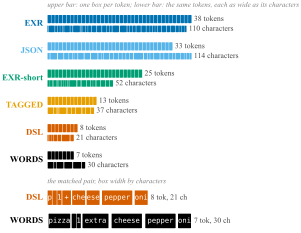
Here's one real test order, "i want a pie with pepperoni and extra cheese":
| Format | Qwen tokens | Target |
|---|---|---|
exr (native) | 38 | (ORDER (PIZZAORDER (NUMBER 1 ) (COM... |
json | 33 | {"orders":[{"type":"p","attrs":[{"n... |
exr-short | 25 | (O (P (N 1) (C (Q EXTRA) (T CHEESE)... |
tagged | 13 | pizza n=1 extra=cheese topp=pepperoni |
dsl | 8 | p 1 +cheese pepperoni |
words | 7 | pizza 1 extra cheese pepperoni |
The key design trick is two matched-length pairs:
exr↔json: about the same length, both bracket-heavy.dsl↔words: identical structure; the only difference is whether a marker is written+cheeseorextra cheese.
If words beats dsl, it can't be because it's shorter.
Characters are not tokens
A fun detail: words is the longer of its pair in characters (43.1 vs 34.9) but costs fewer Qwen tokens (10.3 vs 10.8). +cheese splits into three subwords; extra cheese stays two. Symbols save characters, not tokens.
🧪 The Setup
- Models: Qwen3.5-0.8B and LFM2.5-350M (a largely convolutional model with a ~4× smaller vocabulary).
- Training: LoRA, rank 16, on all linear projections; loss on the completion only; early stopping on dev.
- Grid: 6 formats × 5 training pool sizes (1k → 2.46M) × 5 seeds × 2 models = 300 runs.
- Statistics: hierarchical bootstrap (10,000 resamples over seeds and utterances) with Holm correction, fixed before any result was read.
Every test order lands in exactly one of four buckets:
- ✅ Correct: exact match
- 🤫 Silent error: parses into a tree that's wrong. The caller can't detect it.
- ⚠️ Unparseable: visible, can be retried
- 🙅 Refused: the model said "not an order". Also visible.
We treat the silent rate as the number a deployment should minimise, and report exact match beside it for comparison with prior work.
📊 Result 1: Shorter Is Not Better
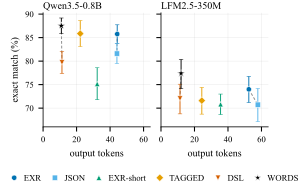
Across the four "length ladder" formats, removing tokens never reliably helped. exr-short, which only renames exr's constructors to single letters, lost 10.6 points on Qwen. Meanwhile tagged, half as long as exr, matched it. Length doesn't predict accuracy in either direction.
📊 Result 2: Surface Form Is What Matters
The matched pair settles it. words beat dsl in 10 of 10 model × pool-size cells, by +7.8 points on Qwen and +5.4 on LFM2 at the full pool.
And on LFM2, the token order inverts: words emits 12.0 tokens vs dsl's 11.4, and is still more accurate. A format that's longer and better isn't winning by being short.
Full-pool results on 1,357 human-written test orders:
| Format | Tokens | Exact match ↑ | Silent ↓ | Latency |
|---|---|---|---|---|
| Qwen3.5-0.8B | ||||
exr | 44.3 | 85.8% | 10.3% | 1171 ms |
json | 44.1 | 81.6% | 14.9% | 1220 ms |
exr-short | 32.3 | 75.2% | 17.4% | 903 ms |
tagged | 22.2 | 85.9% | 11.6% | 616 ms |
dsl | 11.3 | 79.7% | 8.3% | 325 ms |
words | 10.9 | 87.5% | 4.5% | 317 ms |
| LFM2.5-350M | ||||
exr | 52.4 | 74.0% | 17.9% | 821 ms |
words | 12.0 | 77.4% | 10.0% | 186 ms |
For reference, the published BART-Large exr system reaches 78.6% on this test set, trained without our refusal/correction data, so it isn't a like-for-like comparison.
🤫 Result 3: Silent Errors Halve, and Negation Is Why
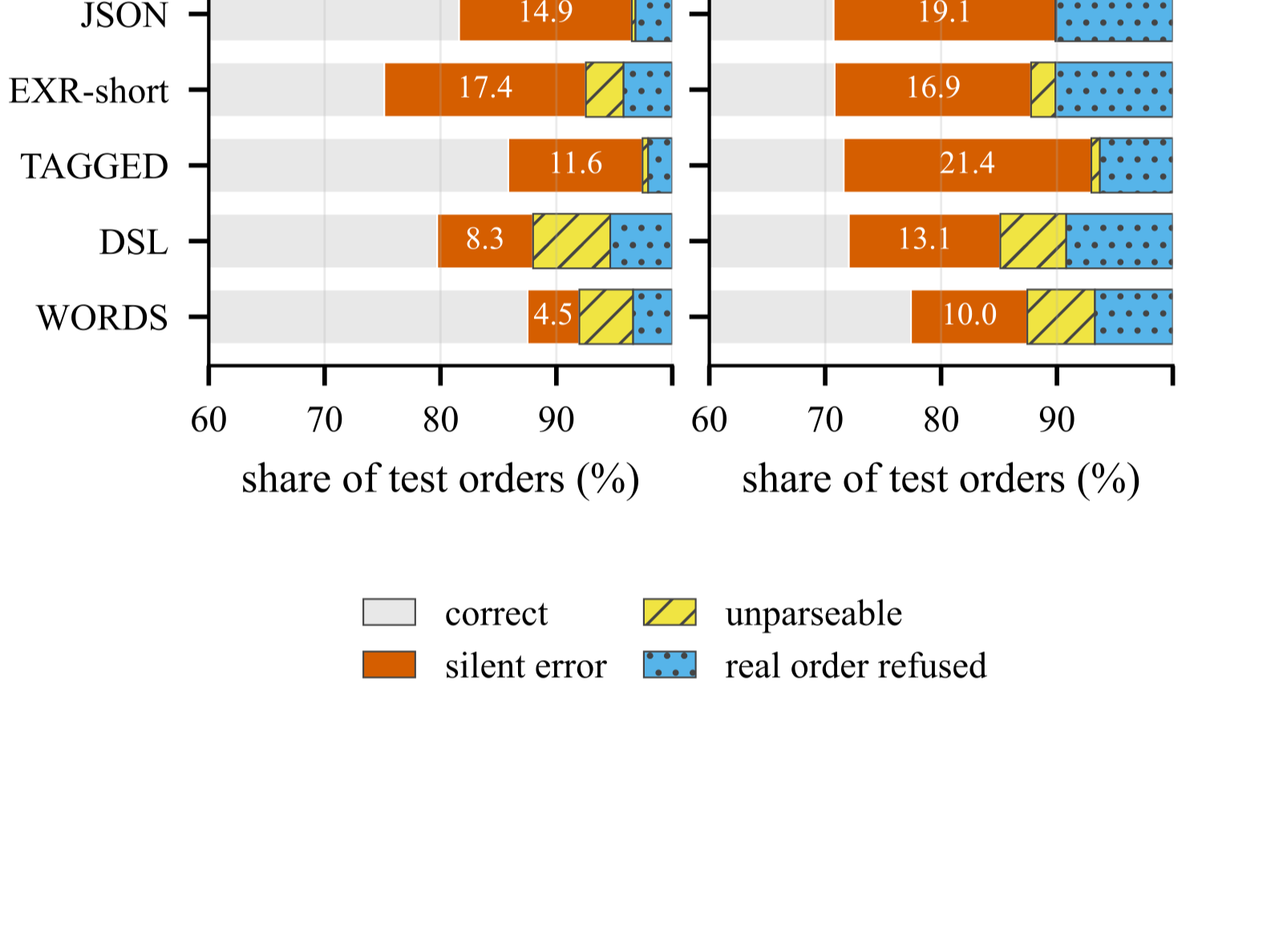
Exact match and silent rate rank formats differently. exr and json almost always parse, so nearly everything they get wrong, they get wrong silently. words fails to parse a bit more often, but those failures are visible.
- Qwen: 4.5% silent with
wordsvs 10.3% withexr, a 2.3× reduction - LFM2: 10.0% vs 17.9%, a 1.8× reduction
- The gap separates at every pool size on both models
When we classified every silent error by what it changed, the biggest difference was negation:
| Format (Qwen) | Silent errors | % that are negation |
|---|---|---|
exr | 698 | 19% |
json | 1011 | 34% |
tagged | 786 | 33% |
dsl | 561 | 30% |
words | 303 | 5% |
As a rate, Qwen makes a silent negation error on 2.0% of orders with exr and 0.2% with words. The reason is almost embarrassingly simple: words writes no onions the way customers say it, while every other format has to translate it into a NOT(...) construct or a ! sigil.
🛡️ The Guardrail: Refusing and Listening
PIZZA has no notion of "not an order": a model trained on it turns "hehe hehe" into a pizza. So every run was also trained on:
- Refusals (30% of training data): chatter, gibberish, off-menu items, orders with an unknown word. The model outputs
?(or the format's equivalent). - Self-corrections (10%): "a pizza with cheese, wait no cheese, only tomato sauce" across nine correction types.
Both were evaluated on held-out vocabulary and cue phrases:
- Held-out negatives refused 95.9–99.0% of the time (format barely matters)
- The cheese self-correction bug a user once reported against an earlier model: fixed in 60 of 60 full-pool runs
wordswas again the best format at applying corrections
The honest price
Strict refusal has a measured cost: 2.1–10.1% of real orders get refused. Reading them, they're genuine orders in human phrasing the synthetic grammar never produces: greetings, thanks, little stories ("i'm having a bunch of people over tonight so i need five pizzas…"). An order containing a greeting, please, or thanks is refused 6.1% of the time vs 2.6% for others. The strict rule meets politeness the training grammar doesn't contain. A refusal is at least a detectable error, so the system can ask again.
📈 It Holds at Every Scale of Data
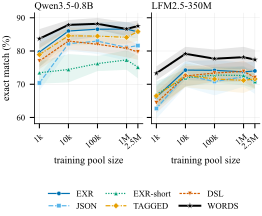
words is the most accurate format at every pool size on both models. Its lead over exr is largest when data is scarce (+4.0 on Qwen, +7.2 on LFM2 at 1k) and narrows with more data, but its lead over the same-length dsl doesn't go away.
⚡ And It's Faster
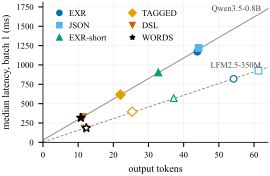
Latency at batch size one is linear in output tokens (Qwen: ~29 ms + 26.5 ms/token), so words answers 3.7× faster than exr on Qwen and 4.4× on LFM2. GPU memory barely moves: format buys you latency and accuracy, not memory.
✅ Limits Worth Stating
- One dataset. PIZZA's training pool comes from a grammar with a small vocabulary; the human-written test set is the main guard against learning the grammar alone.
- Small models. Both are under 1B parameters; the effect may shrink with scale.
- Author-generated guardrail data. Negatives, corrections and probes were generated or written by us.
- Every run includes the guardrail, so this study doesn't measure what the guardrail costs in accuracy.
Conclusion
Output format is a free design variable for a fine-tuned parser, and it's one most people pick for convenience. On PIZZA, writing the target in plain words matches or beats the native format's accuracy with a quarter of the tokens, and roughly halves the errors nobody can detect, mostly by getting negation right.
The recipe that transfers: compress the structure of the target, but keep its vocabulary natural. It costs nothing at inference, needs no new labels, and you can measure it on any parser by splitting results into correct / silent / unparseable / refused.
What happens when this model leaves the server and runs in your browser tab? That's the companion paper: Clean Tickets, Wrong Orders.
Joint work with Maxim Dunaev, Mohammad Nour Al Awad, Sergey Ivanov and Ivan Khodnenko at ITMO University. Thanks to the Hugging Face team for building the interactive Space. Models: pizza-words-gguf and pizza-lfm2-words-gguf.
Cite this
Ahmed, U., Dunaev, M., Al Awad, M. N., Ivanov, S., Khodnenko, I. (2026). Parsed, Plausible, Wrong: Output Format Controls Silent Errors in Small-Model Semantic Parsing. arXiv:2611.17169.
@misc{ahmed2026parsed,
  title         = {{Parsed, Plausible, Wrong: Output Format Controls Silent Errors in Small-Model Semantic Parsing}},
  author        = {Ahmed, Umar and Dunaev, Maxim and Al Awad, Mohammad Nour and Ivanov, Sergey and Khodnenko, Ivan},
  year          = {2026},
  eprint        = {2611.17169},
  archivePrefix = {arXiv},
  primaryClass  = {cs.CL},
  url           = {https://arxiv.org/abs/2611.17169}
}